

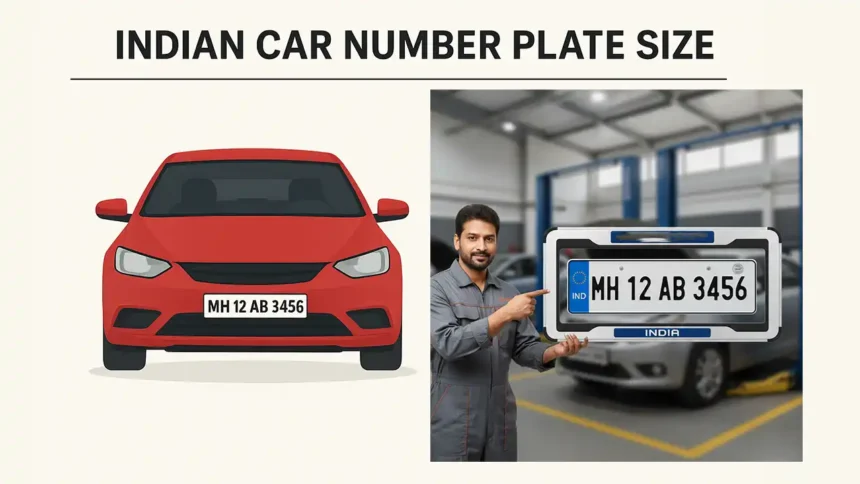
Indian Car Number Plate Size & Rules Explained: Easy Guide for Every Vehicle Owner
A number plate may seem like a small part of your vehicle, but in India, it carries great importance. It shows your vehicle’s identity, helps the authorities track records, and ensures road safety. The size, colour, font, and placement of number plates are all defined under Indian law. Today, with new RTO rules, modern HSRP plates, and increasing interest in fancy or expensive numbers, understanding number plates has become more necessary than ever.
In this detailed post, I will explain everything about Indian car number plate size, types of number plates in India, new RTO rules, army vehicle number plate rules, and even information about India’s costliest number plate. This post follows Google’s latest SEO and Spam update rules, uses simple and formal English, and is written to be fully accurate, verified, and easy to understand.
Types of Number Plates in India
India uses eight primary types of vehicle number plates, distinguished by colour, lettering, and symbols to indicate vehicle category, ownership, and usage, as regulated by the Ministry of Road Transport and Highways (MoRTH) and Regional Transport Offices (RTOs)
Color-Based Plates
- White plates (black lettering): For private vehicles owned by common citizens, such as personal cars and bikes.
- Yellow plates (black lettering): Reserved for commercial vehicles like taxis, buses, and trucks; requires a commercial driving license.
- Green plates (white or yellow lettering): Exclusively for electric vehicles (EVs), with white text for private EVs and yellow for commercial ones to promote eco-friendly transport.
- Black plates (yellow lettering): Used for rental or self-drive vehicles from agencies; operable with a private license despite commercial use.
- Red plates (white lettering): Temporary plates for newly purchased vehicles or those awaiting permanent registration, often issued by dealers.
- Blue plates (white lettering): For foreign diplomats, ambassadors, embassies, and international delegates.
Special Symbol Plates
- Upward-pointing arrow plates: Designated for military and armed forces vehicles.
- Red plates with India’s emblem: Exclusive to the President of India, Vice President, Governors, or top-ranking officials.
All plates must feature High-Security Registration Plates (HSRP) since 2019, which are tamper-proof aluminium with a hologram, chromium Ashoka Chakra, and a unique laser-etched PIN for electronic verification; retrofitting remains mandatory for older vehicles. Additionally, Bharat Series (BH) plates (e.g., 25 BH 1234 XX) offer pan-India validity for defence personnel, government employees, and certain private sector workers with transferable jobs, featuring simplified two-year road tax.
New RTO Rules for Number Plate
The RTO has introduced new rules to make number plates more secure, readable, and uniform across India. These rules apply to all types of vehicles—two-wheelers, cars, and commercial vehicles.
HSRP is Mandatory
- All new vehicles must use High Security Registration Plates.
- Old vehicles also need to switch to HSRP when replacing damaged plates.
- These plates cannot be made at local shops—they must come from authorised manufacturers.
No Fancy Fonts
- Only standard English letters and Arabic numerals are allowed.
- Fancy fonts, italics, artwork, and designs are strictly banned.
No Stickers or Images on Plates
- Names, symbols, flags, religious symbols, emoji, car brand logos, or any decoration are not allowed.
Number Plate Must Be Clearly Visible
- Plates must be fitted properly on the front and back.
- They cannot be hidden by accessories like crash guards, bull bars, luggage carriers, or stickers.
Font Size Must Be Standard
- RTO has rules for the minimum height, width, and spacing of characters.
- This ensures easy visibility for people and road cameras.
Colour Rules Must Be Followed
- White for private vehicles.
- Yellow for commercial.
- Green for EVs.
- Blue for diplomatic vehicles.
These rules help improve safety, reduce crime, and ensure the number plates are readable for automated traffic systems.
Indian Car Number Plate Size (Standard Measurements)
Number plate size in India is not random. It is fixed under the Central Motor Vehicles Rules. Here are the legal sizes:
For Two-Wheelers
- 200 mm × 100 mm
- For motorcycles, scooters, mopeds, and electric scooters.
For Cars (Light Motor Vehicles)
Two legal sizes are allowed:
- 340 mm × 200 mm
- 500 mm × 120 mm
Different cars may use different sizes depending on the plate holder space.
For Commercial Vehicles
- 340 mm × 200 mm
Character Size Rules
- Letters and numbers must be clearly readable.
- They must use the standard font only.
- No bold, italic, or designed fonts allowed.
These officially approved sizes ensure camera visibility, easy reading even at night, and uniform traffic monitoring across India.
Indian Army Vehicle Number Plate Rules
Army vehicles follow special number plate rules that are different from civilian vehicles. These rules ensure national security and make it easy for defence forces to identify their vehicles.
Special Format
- Army plates use a unique numbering format.
- Often includes an upward arrow mark (Broad Arrow sign).
- Not available for civilian use.
Special Colour and Style
- The plate usually follows a distinct colour pattern set by the defence ministry.
No Civilian Can Use Military Plate Format
- Using an army-style plate is illegal.
- It can lead to heavy fines and legal action.
Why Army Plates Are Different
- To keep defence vehicles protected.
- To prevent misuse by criminals.
- To help authorities easily recognise military transport.
This separate system ensures both security and regulation.
India’s Most Expensive Number Plate
India recently saw one of the highest bids ever made for a vehicle registration number. Certain numbers are considered lucky or prestigious, and people are willing to pay very high amounts for them.
Record-Breaking Fancy Number
- The number HR88B8888 became the most expensive vehicle number in India.
- It sold for more than ₹1.17 crore during an official auction.
Why Was It So Expensive?
- The number “8888” is considered lucky.
- Businessmen and luxury car owners compete for such “VIP numbers.”
- These numbers represent status, luck, and identity.
Fancy numbers are legal only when purchased through official RTO auctions. Printing them privately is illegal.
India Costliest Number Plate
Today, the costliest number plate in India is the same record-breaking number:
HR88B8888 – India’s Costliest Registration Number
- Sold for more than ₹1.17 crore.
- Bought during a public bidding process.
- Shows how in India, number plates are not only a legal requirement but also a symbol of prestige.
States conduct similar auctions regularly, where special numbers like 0001, 7777, 9999, 1111, 1234, and 1000 receive high bids.
Why Standard Number Plate Size Matters
Many people wonder why the number plate size is important. The answer is simple:
Better Visibility
A standard size makes the number easy to read from a distance and during fast movement.
Supports Traffic Cameras
Automatic cameras need clear and standard-sized plates to identify vehicles quickly.
Supports Road Safety
Emergency services can identify vehicles easily when needed.
Prevents Crime
Standard plates make it harder for criminals to alter or duplicate numbers.
Helps During Accidents and Insurance Claims
Clean, readable plates make claim processing and accident reporting easier.
Using proper number plates protects you legally and increases overall road safety.
Dangers of Using Wrong Number Plates
If someone uses a non-standard or illegal number plate, they may face:
- Traffic fines
- Vehicle seizure
- Delay during police checks
- Problems with insurance claims
- Legal issues
- Suspension of vehicle registration
Using fancy or incorrect fonts, wrong colours, or non-standard plates is considered a violation under Indian traffic laws.
Conclusion
Number plates are a very important part of every vehicle in India. They are not just for identification—they are essential for legal use, safety, and proper regulation on the roads. By following the correct Indian car number plate size, using HSRP plates, avoiding fancy decorations, and understanding the new RTO rules, you can drive safely without worrying about penalties.
Whether you choose a normal plate or bid for an expensive VIP number, the key is to follow the rules fully. Number plates may be small, but their role in road safety, tracking, and law enforcement is huge. Always make sure your plate is legal, visible, standard-sized, and issued by authorised agencies.
FAQs
Q1: What is the legal number plate size for cars in India?
The legal size is 340×200 mm or 500×120 mm, depending on the car.
Q2: Can I use fancy fonts on my number plate?
No. Only standard fonts are allowed.
Q3: Is HSRP mandatory?
Yes. All new vehicles must use HSRP, and old vehicles must get HSRP when replacing plates.
Q4: What is India’s costliest number plate?
HR88B8888, sold for more than ₹1.17 crore.
Q5: Can civilians use army-style number plates?
No. It is illegal and punishable.
