Download E Shram Card, Benefits List, Eligibility, Registration & Payment Status Check
- Launched: 26 August 2021 — National Database for Unorganised Workers (NDUW)
- Registration fee: Completely FREE (online or at a Common Service Centre)
- What you get: Lifetime 12-digit Universal Account Number (UAN) card
- Registered workers: 30 crore+ unorganised workers across India
- Age limit: 16–59 years · Must not be an EPFO/ESIC member or income-tax payer
What is the E Shram Card?
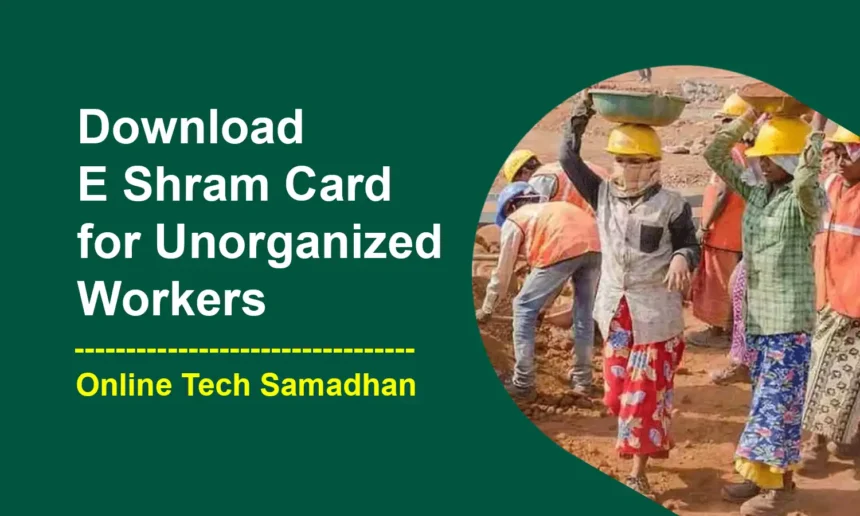
The e-Shram Card is a free digital identity card for India’s unorganised-sector workers — construction workers, agricultural labourers, domestic workers, street vendors, gig and platform workers, and self-employed people. Launched on 26 August 2021 by the Ministry of Labour & Employment, it creates the National Database for Unorganised Workers (NDUW) and gives every registered worker a permanent, portable 12-digit Universal Account Number (UAN) that remains valid across India — even if you migrate between states for work.
Its purpose is to make sure the benefits of government social-security schemes actually reach the workers they are meant for, by maintaining accurate, verified data on India’s unorganised workforce.
Objectives of e-Shram
- Give every unorganised worker a national, portable work identity (UAN).
- Build an accurate national database to help the Central and State governments plan and target welfare schemes.
- Enable direct delivery of social-security benefits, relief transfers and skilling opportunities.
- Improve traceability of migrant workers so disaster-relief and emergency support reach them faster.
Who is Eligible?
| Criteria | Requirement |
|---|---|
| Occupation | Unorganised-sector worker — construction, agriculture, domestic work, street vending, gig/platform work (Ola, Uber, Amazon, Flipkart, Swiggy etc.), home-based or self-employed work |
| Age | 16 to 59 years |
| Exclusions | Must not be a member of EPFO or ESIC, and must not be an income-tax payer |
| Documents | Valid Aadhaar, Aadhaar-linked mobile number, bank account details |
E Shram Card Benefits List (Verified)
| Benefit | What you actually get |
|---|---|
| 🛡️ Accident Insurance (PMSBY) | ₹2 lakh for accidental death or permanent total disability; ₹1 lakh for permanent partial disability — linked automatically at registration |
| 🆔 Lifetime UAN | Permanent 12-digit national work ID, valid pan-India, portable across states and jobs |
| 👵 Pension access (PM-SYM / APY) | Eligibility route to PM-SYM (₹3,000/month pension after 60) and Atal Pension Yojana — separate enrolment required |
| 🏥 Health scheme linkage | Several states use e-Shram data to fast-track Ayushman Bharat (PM-JAY) coverage for registered workers |
| 🏦 Credit & livelihood schemes | Priority access to PM Vishwakarma, PM SVANidhi and similar schemes that use UAN for verification |
| 🚨 Emergency relief | Verified database enables targeted disaster/crisis relief transfers to affected workers |
| 🎓 Skill development | Registration data helps route skilling and upskilling programme offers to workers |
How to Register Online (Step by Step)
- Go to the official portal: https://eshram.gov.in and click “Register on e-Shram”.
- Enter your Aadhaar-linked mobile number and the captcha shown on screen.
- Select “NO” for EPFO and ESIC membership when asked (if applicable).
- Choose “Send OTP” and enter the OTP received on your mobile.
- Enter your Aadhaar number and verify — your name, photo and basic details auto-fill from Aadhaar.
- Fill in your address, education, occupation, monthly income and bank account details.
- Add a nominee (important — the nominee receives the insurance benefit).
- Accept the terms, verify all details and submit.
- Your 12-digit UAN is generated instantly, and you can download the e-Shram (UAN) card.
How to Check Payment Status (2026)
Since the e-Shram card itself does not pay any amount, there is no “card balance”. Here is what you can check — all free, all official:
- Card / UAN status: Visit eshram.gov.in → click “Already Registered? Update” → log in with your UAN + date of birth + OTP to view and update your registration.
- Scheme payments (pension, relief, insurance): Check the specific scheme’s own portal — e.g. PM-SYM at maandhan.in — using your UAN or account details.
- Bank account: Any approved benefit is credited directly to your linked bank account — verify from your bank passbook / UPI statement / bank SMS.
- State-specific benefits: Many states (UP, MP, Rajasthan, Bihar and others) run their own e-Shram-linked schemes — check your state labour department’s official website.
- Helpline: Call 14434 or 1800-889-6811 (9:00 AM – 6:00 PM, all days) or file a grievance through the Grievance section of the e-Shram portal using your UAN.
How to Download the E Shram Card
- Open eshram.gov.in and click “Update” (Already Registered).
- Log in with your UAN, date of birth and the OTP sent to your registered mobile.
- Click “Download UAN Card” — the e-Shram card PDF is saved to your device.
Video Guide (Hindi)
FAQs
Is there any fee for e-Shram registration?
No. It is completely free — online at eshram.gov.in or at a CSC centre.
What is the ₹2 lakh benefit?
Accidental death/permanent total disability cover of ₹2 lakh (₹1 lakh for partial permanent disability) under PMSBY, linked at registration.
Does the e-Shram card pay a monthly amount?
No. The card is an identity/database card. Payments come only from schemes you separately enrol in.
What is the last date for registration?
There is no deadline — registration is open, but workers are advised to register early and keep their profile (occupation, bank details) updated for continued benefits.
Is the card available in Hindi?
Yes — the portal supports Hindi and several regional languages via the language selector.
Sources & Disclaimer
- Official e-Shram Portal (Ministry of Labour & Employment): eshram.gov.in — registration, FAQs, objectives, help & grievance
- e-Shram Helpdesk: 14434 / 1800-889-6811 (9 AM–6 PM daily)
- e-Shram self-registration page: register.eshram.gov.in
This article is for informational purposes only. Scheme rules, coverage amounts and eligibility are set by the Government of India and may change — always verify current details on the official portal or helpline before acting. Last reviewed: 22 October 2026.